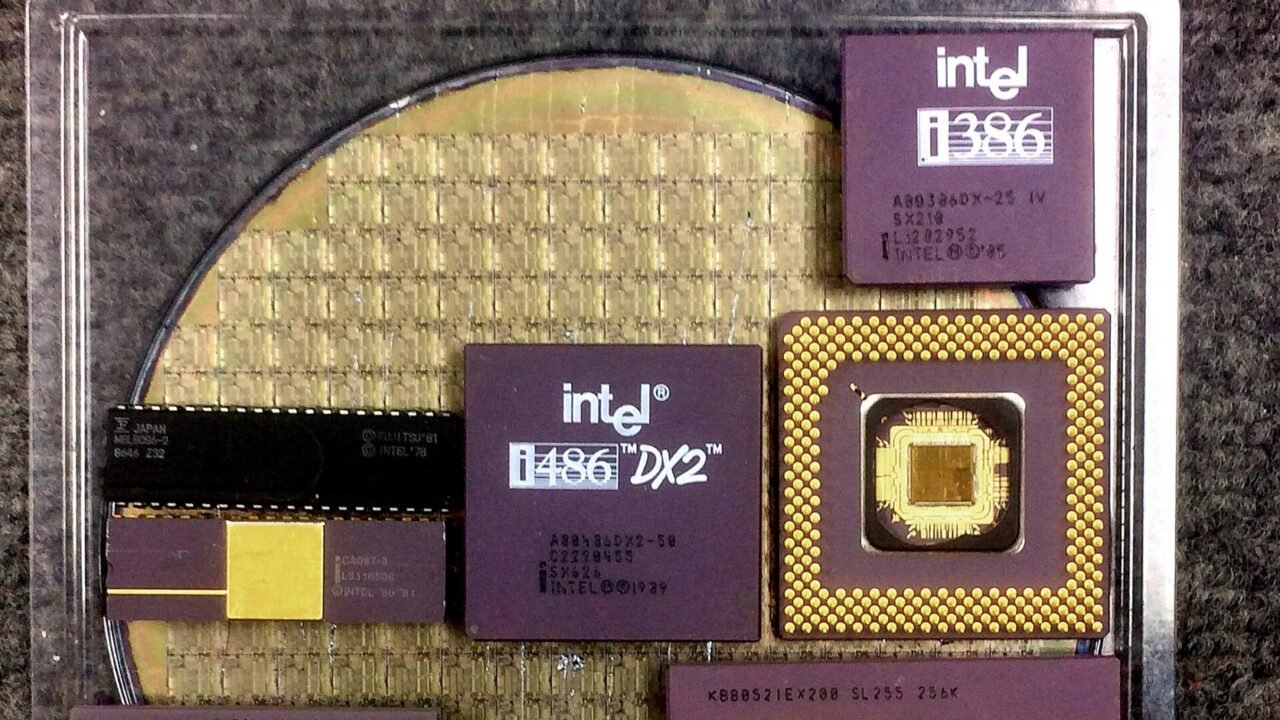
Computers filled rooms before they fit on a desk, in a pocket or inside an appliance. This reduction did not happen just because the pieces became smaller. Transistors replaced vacuum tubes, integrated circuits brought components together, and the microprocessor placed the central processing unit on a general-purpose circuit.
Knowing this sequence helps to understand why a current chip concentrates billions of elements and why frequency, number of cores and architecture cannot be compared in isolation.
Valves Made Electronic Computing Possible#
Early electronic machines used valves to control signals. They allowed fast operations for the time, but they took up space, consumed energy, generated heat and failed frequently. Maintenance was a constant part of the operation.
These computers were not large versions of a modern notebook. Input, memory, programs and peripherals followed their own limitations. Still, they established electronic processing concepts that would be refined in the following decades.
The Transistor Has Changed Scale And Reliability#
The transistor acts as an electrically controlled switch or amplifier. Smaller and more efficient than the valve, it allowed for more compact and reliable equipment. Production in semiconductor materials has paved the way for manufacturing many components with repeatable processes.
A transistor alone is not a computer. The advance came from the possibility of combining large quantities in circuits that represent logic, memory and control. The history of storage followed another transformation, described in the article about magnetic disks and SSDs.
Integrated Circuits Gathered Components#
Instead of connecting each transistor as a separate part, integrated circuits manufacture multiple elements on the same substrate. This reduces external connections, size and cost per function, while increasing complexity. Specialized chips began to perform tasks that previously required entire boards.
Integration has evolved over generations. Manufacturing, computer-aided design, and encapsulation techniques have allowed us to pack more logic into small areas. Not all gains came from reducing dimensions; architecture, cache memory and parallelism also changed performance.
The Microprocessor Put the CPU Into a Circuit#
A microprocessor brings together the unit capable of searching, interpreting and executing instructions. In 1971, the Intel 4004 became a commercial milestone of this integration. It had modest features by today’s standards, but it showed that a general-purpose CPU could exist on a programmable chip.
IBM introduces the 4004 and the fetch and execute cycle when explaining microprocessors. The innovation helped replace customized sets with a base that could perform different tasks depending on the program.
Fetch, Decode & Execute#
Simply put, the CPU searches for an instruction in memory, decodes what it means and executes the operation. Registers store values close to the calculation unit, while caches reduce access time for frequently used data. The result can go to memory, storage or peripherals.
This cycle repeats billions of times, but modern processors work with multiple instructions in different steps, multiple cores and prediction mechanisms. The basic explanation is useful without suggesting that everything happens in a simple queue.
Frequency Doesn’t Tell the Whole Story#
Gigahertz indicates cycles per second, but different architectures do different amounts of work per cycle. Additional cores help when software distributes tasks, and larger caches reduce some waiting. Thermal and power limits also change the maintained frequency.
Compare results in the desired application, with similar consumption and cooling. A notebook chip seeks a different balance than a desktop processor or microcontroller. Family and generational names are most informative when accompanied by appropriate specifications and tests.
CPU, GPU And Microcontroller Have Different Focuses#
The CPU is versatile and coordinates the system. The GPU works well with a large number of parallel operations, originally aimed at graphics and now also used in calculations. Microcontrollers bring together processing, memory and interfaces to control sensors, toys, vehicles and household appliances.
These categories can come close together. Systems on a chip combine CPU, GPU, accelerators, communication and other blocks. A modern cell phone doesn’t rely on a single core doing everything; tasks are routed to the most appropriate block.
Microcontrollers also appear in machines such as the 3D printer that transforms files into layers, coordinating sensors, temperatures and motors according to instructions prepared by the software.
Software Also Participates in Performance#
Compilers transform programs into instructions for a given architecture. The system distributes processes and memory, while applications decide how many cores to use. A powerful processor can be limited by storage, low RAM, cooling, or poorly tuned code.
Before changing hardware, follow the RAM and Storage and Slow Computer diagnostics sequence. Identifying the bottleneck avoids buying CPU when the problem is in startup, full disk or background process.
Fun Fact: A Modern Chip Is Also A Network#
As blocks multiplied, it became necessary to move data within the chip itself. Interconnects link cores, caches, and controllers as a small communications infrastructure. Physical distance and energy to transport bits matter in design.
This view shows why “more transistors” does not automatically translate into performance. They need to be organized, powered, cooled, and used by software. Architectural engineering transforms quantity into useful capacity.
Security features may use specific modules and instructions, but recovery is still up to the user. The disk encryption and recovery keys guide shows this relationship in everyday use.
Conclusion#
Valves opened the electronic age, transistors reduced scale and consumption, integrated circuits brought together components and microprocessors placed a programmable CPU on a chip. Current advancement combines manufacturing, architecture, memory, power and software.
When comparing processors, look beyond gigahertz. Generation, cores, performance per task, consumption and the rest of the system better explain the real experience.
Frequently Asked Questions#
Are Microprocessors and CPUs the Same Thing?#
CPU is the processing unit. Microprocessor is its implementation on an integrated circuit; Modern products may include several blocks in addition to the CPU.
Are More Cores Always Better?#
They help when the software distributes work and when power and temperature allow. Some tasks depend more on the performance of a few cores.
Why Can a Smaller Chip Be Faster?#
Architecture, manufacturing process, cache, frequency, power and software all participate. External physical size does not reveal internal capacity.
Featured image: Photo: Bill Smith — CC BY 2.0, via Wikimedia Commons. Cropped for the featured image. Source and attribution.